Rooftop Solar Hot Water: Why You’re No Longer Stuck with the “Standard” Setup
If you’ve lived in New Zealand for a while, you’re probably familiar with the classic rooftop solar hot water system. Brands like Solahart paved the way, featuring a large water tank sitting on the roof right next to big solar collection panels.
For years, this was the go-to choice for eco-conscious Kiwis looking to slash their power bills. Don’t get us wrong—compared to a standard, old-school electric hot water cylinder, a traditional solar system absolutely saves you money. There is no question about that.
But if your old rooftop system is on its way out, or if you’re looking to install a new one, you need to know that technology has moved on. You are no longer locked into that traditional setup, and there is a much smarter, more reliable option available.
The Catch with Traditional Solar: The “Hidden” Power Bill
Traditional solar hot water systems rely entirely on direct sunlight. When the Kiwi sun is blazing, they work great. But as we all know, New Zealand weather can be unpredictable, and the sun eventually goes down every single night.
Because a typical family of four uses the majority of their hot water at night (showers, dinner dishes, baths), a conventional 300L solar system has to rely on a built-in 3kW electric backup element to ensure you still have hot water the next morning.
Here is how that power usage actually breaks down for a family of four:
- In Summer: On a beautiful sunny day, the panels do all the work (0 kWh used). About 70% of the time, summer demand is low enough that the backup element isn’t needed at all. However, the other 30% of the time, that 3kW element kicks in for about 2 hours at night to top the tank up, consuming 6 kWh per day.
- In Winter: With shorter days, cloudy skies, and colder ambient water temperatures, the panels can’t keep up. The system has to run the 3kW element for an additional 2 hours during the day on top of the 2 hours at night. That is 4 hours total at 3kW, consuming 12 kWh every single day.
These numbers are estimated based on an average of manufactures savings for a traditional solar system installed vs a standard electric hot water cylinder.
The Smarter Alternative: Rooftop Tank + Heat Pump Combo
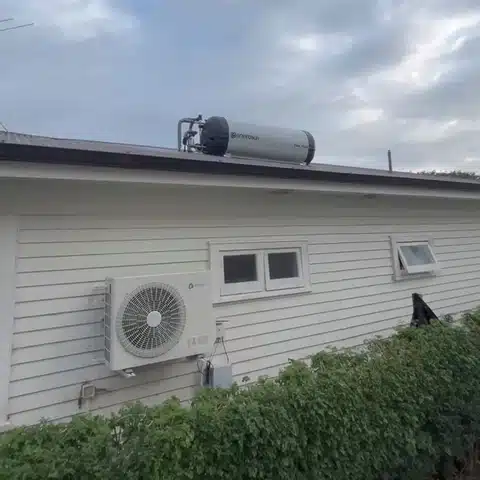
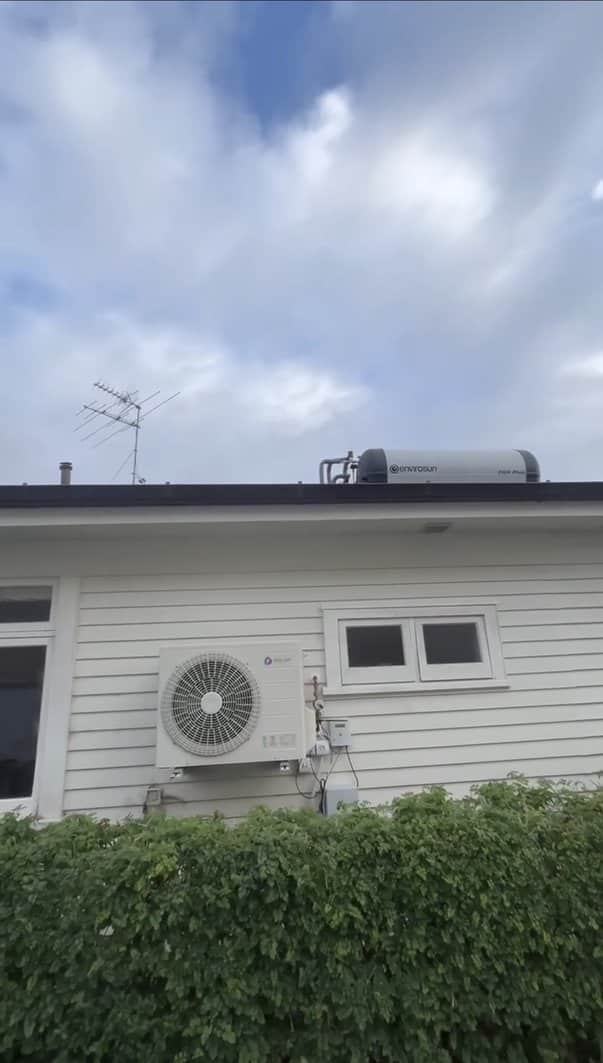
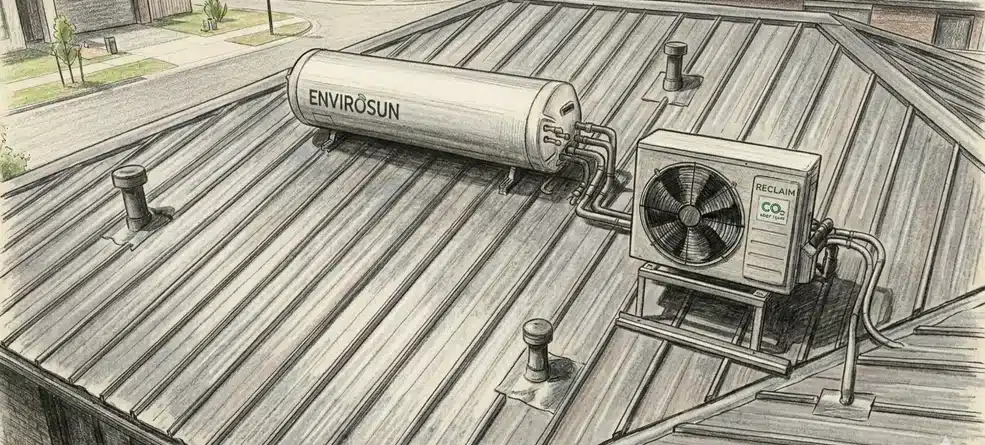
Instead of pairing your 300L rooftop tank with traditional solar collection panels, we pair that rooftop tank with a split hot water heat pump compressor. Unlike solar panels that only heat when the sun is up, heat pumps extract ambient heat from the surrounding air. They work day or night, rain or shine, 365 days a year.
Because a heat pump multiplies the energy it draws from the air rather than relying on a brute-force electric element, the efficiency is staggering.
📊 Real Kiwi Case Study
We are currently tracking a real-world system right here in New Zealand. We have a family of four—two adults and two teenage boys (notorious for long showers!)—using this exact 300L rooftop tank + heat pump combo.
The data shows that this system consistently uses just 2.5 to 3.5 kWh per day, 24/7, 365 days a year, regardless of the weather. (Stay tuned to our blog for month-on-month data updates on this project coming soon!)
Crunching the Numbers: Traditional Solar vs. Heat Pump
Let’s look at how the math stacks up. To make this realistic, we will average out the traditional solar usage across the year (accounting for the good summer days and the heavy winter usage) to an average of roughly 7.5 kWh per day. We will compare that to our heat pump case study averaging 3 kWh per day.
Note: For these calculations, we’ll use an average New Zealand electricity rate of $0.33 per kWh.
| Time Period | Traditional Solar (Avg. 7.5 kWh/day) | Rooftop Tank + Heat Pump (Avg. 3 kWh/day) | Your Total Savings |
|---|---|---|---|
| Over 1 Year | $903.38 (2,737.5 kWh) | $361.35 (1,095 kWh) | $542.03 saved |
| Over 5 Years | $4,516.90 | $1,806.75 | $2,710.15 saved |
| Over 10 Years | $9,033.80 | $3,613.50 | $5,420.30 saved |
The Difference is Clear:
- Over 1 Year: You keep an extra $542 in your pocket.
- Over 5 Years: The heat pump setup saves you over $2,700—frequently paying back the investment of the upgrade itself.
- Over 10 Years: You avoid wasting over $5,400 on unnecessary electricity.
Ready to Upgrade Your Roof?
If your current rooftop solar system is getting old, leaking, or costing you too much in backup power during the winter months, don’t just default to replacing it with the exact same thing, have a chat to our hot water heat today.
You can keep your roof space free, maybe for a larger solar PV system or free up the inside of your house, and enjoy genuinely low power bills all year round—sun or no sun.