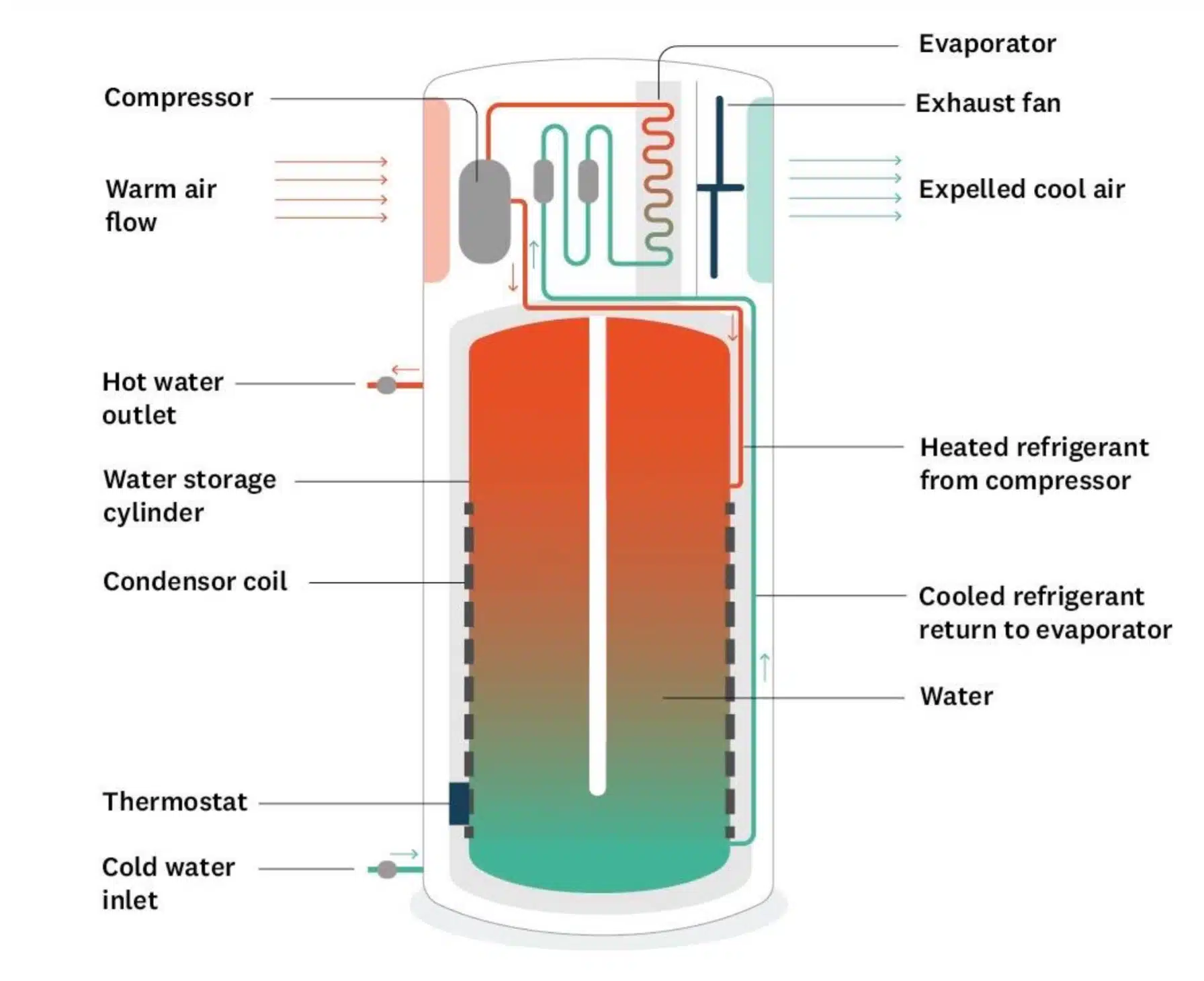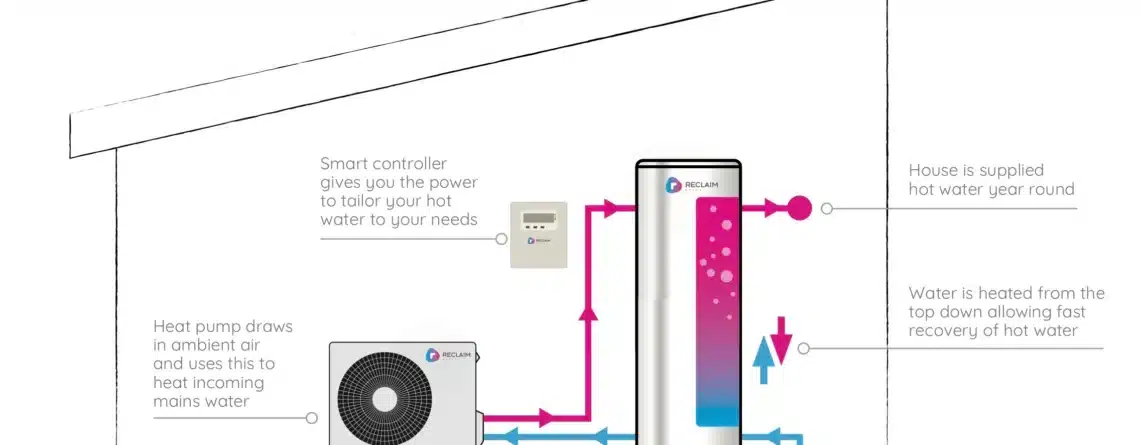
A hot water heat pump operates like a refrigerator working in reverse. Instead of pumping heat out of a fridge to keep it cold, it extracts ambient heat from the outside air and pumps it into your water cylinder.
Because it is moving heat rather than creating it through an electrical resistance element (like a standard hot water cylinder) or by burning fuel (like a gas califont), it is incredibly efficient.
The 4-Step Heating Cycle:
- Evaporation: A fan draws outside air over an evaporator component containing a special, eco-friendly refrigerant fluid. Even on cold New Zealand winter days, there is still usable heat energy in the air. The refrigerant absorbs this heat and boils into a gas at a very low temperature.
- Compression: A compressor pumps up the pressure of this gas. Just like pumping up a bicycle tyre makes the pump feel warm, compressing the gas rapidly concentrates the heat, raising its temperature significantly.
- Condensation (Heat Transfer): The hot, pressurized gas travels through a heat exchanger wrapped around or connected to your water tank. The heat naturally transfers from the hot gas into your domestic water. As the gas loses its heat to the water, it cools down and condenses back into a liquid.
- Expansion: The liquid refrigerant passes through an expansion valve, lowering its pressure and cooling it right back down, ready to start the loop all over again.
Efficiency: The 1-4+ Advantage
The core metric for heating efficiency is the Coefficient of Performance (COP).
- Standard Electric Cylinder / Gas Califont: Has a COP of roughly 1.0. This means for every 1 kW of energy you pay for, you get exactly 1 kW of heat energy out.
- Hot Water Heat Pump: Typically operates at a COP between 3.0 and 5.0+ under standard New Zealand conditions. For every 1 kW of electricity you buy to run the compressor and fan, the system pulls an additional 3.0 to 5.0+ kW of heat out of the air for free. You end up with 3.0 to 5.0+ kW of thermal energy delivered to your water.
The Bottom Line: This massive leap in efficiency immediately slashes your water heating power usage by up to 80%.
Typical Payback Period for Kiwi Households
Water heating makes up roughly 30% of the average Kiwi household’s energy bill. Because of this high baseline usage, switching to a heat pump system offers one of the fastest returns on investment of any eco-upgrade.
The exact payback period depends on your household size, your current heating fuel (gas vs. standard electric), and your location, but the general breakdown looks like this:
The Financial Breakdown
| Metric | Standard Electric / Gas Cylinder | Advanced Hot Water Heat Pump |
|---|---|---|
| Estimated Annual Running Cost (Family of 4) | $1,100 – $1,400+ | $300 – $400 |
| Annual Savings | — | $800 – $1,100+ per year |
| Upfront Installation Cost (Approx.) | $3,500 – $,500 | $6,500 – $9,000 |
| The “Premium” Over Standard | — | $4,000 – $5,500 |
Your True Payback Window
Because the price gap between a standard replacement and a high-efficiency heat pump is much narrower than most people think, your return on investment happens much faster:
Scenario A: Your current hot water system has died (or you are building new)
If you are forced to spend $3,500 to $4,500 anyway just to get the hot water running again, your true investment in “going green” is only the price difference.
The Extra Investment: Only about $3,000 to $4,500.
The Return: With the heat pump cutting your power bill by roughly $1,000 every single year, you wipe out that extra investment in just 3 to 4.5 years. After that point, the system is pure profit, putting $1,000 back into your household budget every year for the rest of its 15-year lifespan.
Scenario B: Proactively upgrading a working, older cylinder
If your existing system works fine but you want to slash your high power or gas bills proactively, you absorb the full upfront cost.
The Investment: $6,500 – $9,000.
The Return: Even with the full capital outlay, a payback period of 6 to 8 years easily beats standard financial investments. Furthermore, you instantly increase your property’s value and future-proof it against rising energy line charges.
Factoring in Smart Financing
Many New Zealand banks now offer 0% or 1% interest “clean energy” top-ups on home loans for energy-efficient upgrades. If you finance an $8,000 heat pump at 1% interest, your monthly loan repayments are often lower than the money you are instantly saving on your power bill. The upgrade effectively funds itself from month one.