Calculating the right size for a solar panel and battery system isn’t about buying a “one-size-fits-all” kit. It requires a balance between what your home consumes, when it consumes it, and your future electrification goals.
Data from Rewiring Aotearoa indicates that the average New Zealand household uses between 19 and 25 kWh of electricity per day (7,000 to 9,000 kWh annually).
Here is the exact step-by-step framework that specialists like Mainly Energy use to size a system precisely for a standard Kiwi family home.
Step 1: Size the Solar Array (Based on Daily Usage & Future Needs)
Your solar panel array needs to generate enough power during daylight hours to run your daytime appliances, top up your battery, and account for winter drops in production.
The Formula:
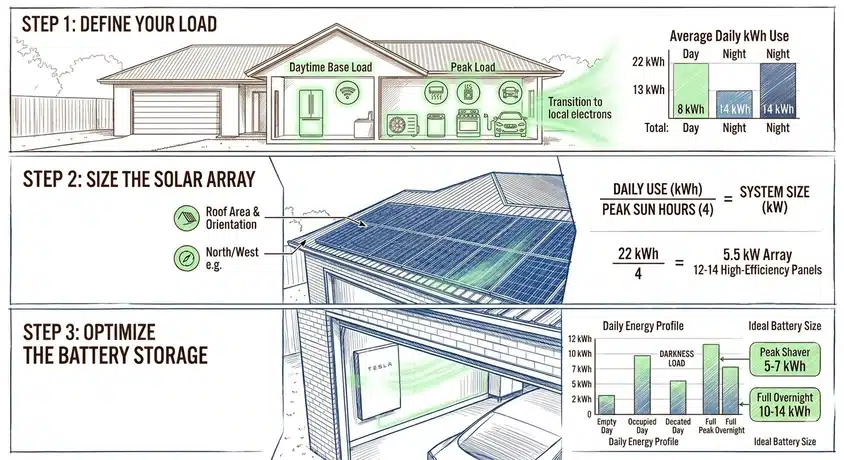
To find your baseline system size, take your average daily kWh usage and divide it by your region’s peak sun hours. New Zealand averages roughly 4 peak sun hours per day over the year.
System Size (kW) = Average daily Usage (kWh) / Peak Sun Hours (4)
- Standard Family Example (22 kWh/day): 22 / 4 = 5.5kW System.
- Using modern, high-efficiency 440W panels, a 5.5 kW system requires about 12 to 14 panels (occupying roughly 20–22 m² of unshaded roof space).
The “Future-Proof” Rule:
We strongly recommends installing the largest solar array your roof space and budget can realistically fit. It is far cheaper to install a larger array at day one than to try and add panels later. If you plan to add an electric vehicle (EV) or swap a gas heater for an efficient heat pump, your daily baseline will increase.
- Recommendation: Aim for a 9 kW system (18 to 22 panels) to easily absorb future electric vehicle or winter space-heating loads.
Step 2: Size the Battery (Based on Your “Darkness Load”)
Unless you are completely off-grid, you do not need a battery large enough to run your entire house for days. A grid-tied hybrid battery is sized strictly to handle your “darkness load”—the power you consume between 5:00 PM and 7:00 AM.
This ensures you avoid importing grid power during the most expensive, peak-tariff evening and morning hours.
The Sizing Tiers:
- 5 kWh to 7 kWh Battery (The Peak-Shaver): Ideal for families who just want to wipe out their evening peak grid usage (cooking, washing, evening TV). A 5.1 kWh battery typically provides roughly 7 hours of standard home autonomy.
- 10 kWh to 14 kWh Battery (The Full Overnight): The sweet spot for a standard Kiwi family home. This size easily carries your home’s baseline overnight running costs (fridges, standby power, evening heat pumps) all the way through to the next sunrise. It also offers a great layer of emergency backup if the local grid goes down.
- 15+ kWh Battery: Recommended only if you are heavily heating a large home with ducted heat pumps overnight, charging an EV at night completely off the battery, or pursuing partial grid independence.
The Standard “Kiwi Sweet Spot” Configurations
Based on real-world system designs rolled out across New Zealand, most standard 3-to-4-bedroom family homes yield the highest financial returns with one of these two setups:
Option A: The “Standard Family” Setup
- Solar Array: 5.3 kW to 6.1 kW (12–14 Panels)
- Battery Storage: 5 kWh to 10 kWh
- Best For: Homes with moderate daytime occupancy or automated smart appliances (timer-shifted dishwashers/washing machines) that want to flatten their evening power bill.
Option B: The “High-Efficiency / Future-Proofed” Setup
- Solar Array: 7.0 kW to 9.0 kW (16–20 Panels)
- Battery Storage: 10 kWh to 14 kWh (e.g., Tesla Powerwall or SolaX Modular units)
- Best For: Families with a high electrical demand, an electric vehicle charging at home, or households aiming to cut 80%+ of their grid consumption.
Summary Checklist for Sizing
- Grab your power bill: Find your average daily usage in kWh (usually listed on the back of your bill or via your power retailer’s app).
- Identify your peaks: If your house is empty during the day, you will need to skew your budget heavily toward a slightly larger battery to store that daytime sun for the evening.
- Assess your roof: Ensure you have enough unshaded roof space facing Northwest to Northeast. Each panel requires about 1.6 to 1.7 square meters.
Partnering with Certified Local Installers:
At Mainly Energy, we don’t believe in a one-size-fits-all, hands-off approach. We operate on a partnership basis, working directly alongside trusted, independent local solar and heat pump installers across New Zealand to design and deploy your system.
By combining our structural energy planning with the hands-on expertise of certified local professionals — including specialists like Switch Electrical and Consolidated Energy — you get the absolute best of both worlds: independent, data-backed optimisation and flawless, compliant local craftsmanship.
Why Our Partnership Model Works for You
Custom Local Design: Your system isn’t designed by a computer algorithm overseas. We partner with local technicians who understand your region’s specific microclimate, wind zones, council compliance rules, and network line constraints.
Vetted, Certified Craftsmanship: Every local partner in our network is fully vetted, licensed, and certified. This ensures your installation meets strict New Zealand standards and effortlessly qualifies for major banks’ 1% clean energy home loan top-ups.
Ongoing Local Support: Because your installation is handled by a dedicated specialist in your community, you have a local point of contact for ongoing maintenance, warranty support, and future system expansions.
Ready to Design Your Perfect System? Let’s Talk.